Which business processes should you automate first?
Updated October 15, 2026 · 3 min read
Start with work that happens every day, follows the same rules each time, and causes problems when it goes wrong: quotes, bookings, invoices, stock levels and reporting. These pay back fastest, because the saving repeats every week and the errors they remove are the ones customers notice. Leave judgement calls and one-off work to people.

Where the hours go
In most small businesses, the time doesn’t disappear into one big task. It leaks out of small ones:
- typing the same customer details into the quoting tool, the job sheet and the invoice;
- chasing approvals by email;
- answering “where’s my order?” by phone;
- counting stock by hand;
- building the monthly report from three spreadsheets;
- re-quoting jobs that differ from the last one in two details.
Each takes minutes. Together they take days every month, and they’re the same days every month.
A three-question test
For each process, ask how often it runs, whether it follows the same rules each time, and what a mistake costs. The more often it runs and the more rule-based it is, the sooner it should go.
| Process | How often | Same rules? | Cost of a mistake | Automate |
|---|---|---|---|---|
| Quotes for standard jobs | Daily | Mostly | Lost jobs, wrong margins | First |
| Invoices and payment reminders | Daily | Yes | Late cash | First |
| Bookings and scheduling | Daily | Mostly | Double bookings, idle staff | First |
| Stock levels and reorders | Weekly | Yes | Running out | Next |
| Monthly reporting | Monthly | Yes | Late decisions | Next |
| Custom design or advice | Varies | No | Unhappy client | Keep with people |
Our assessment. Adjust the rows to your own business.
Short-term cost, long-term return
Software spending looks expensive in the month you pay for it. Over the life of the tool, it usually isn’t, because the build is paid once and the time it saves comes back every week.
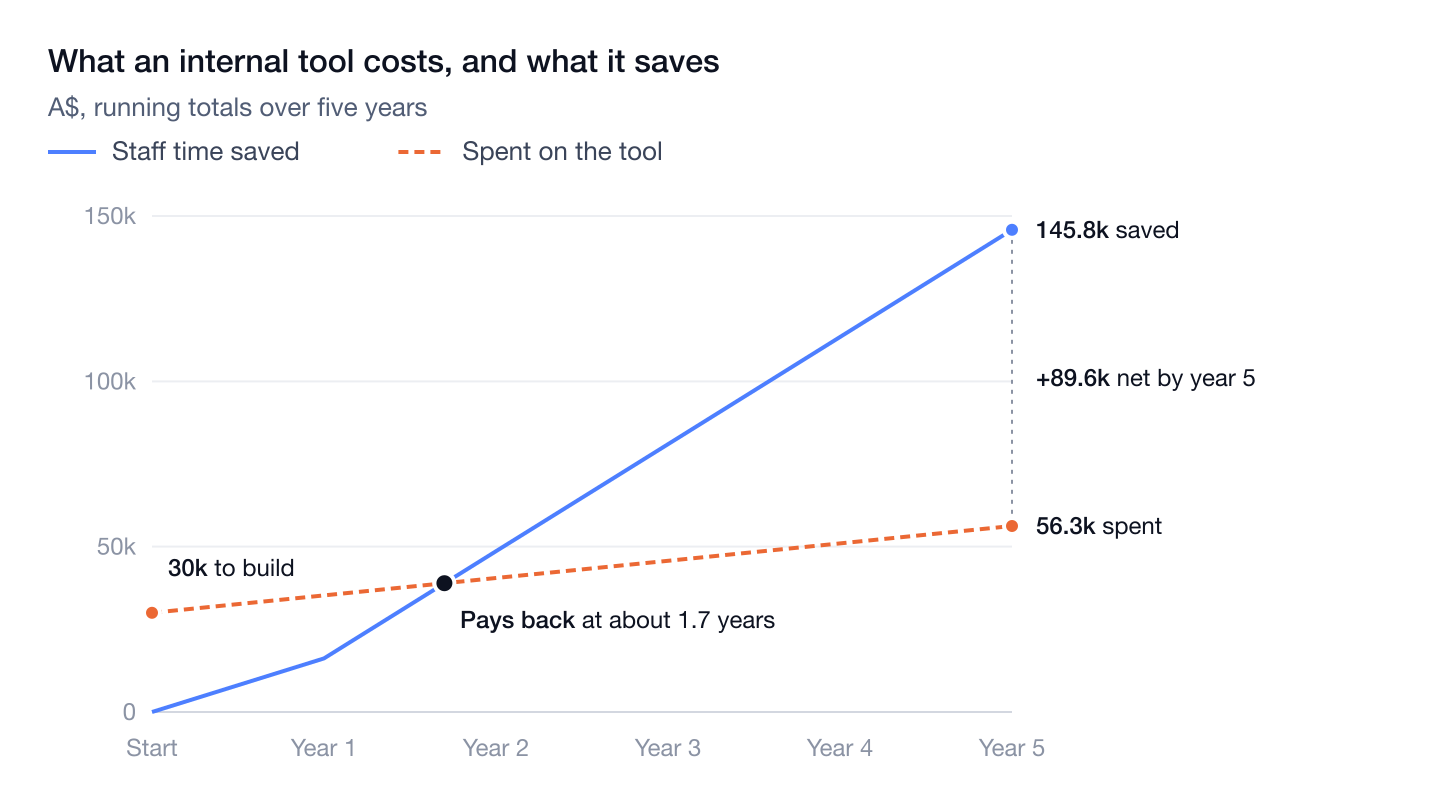
In this example the tool pays for itself in under two years. Over five years it returns about A$2.60 for every dollar spent, or A$89,550 more than it cost, and that’s before counting fewer errors, faster quotes or work the team can now take on without hiring. The cost is front-loaded and fixed; the saving repeats and grows with the business.
Build prices in 2026 range widely, so put in your own numbers.
What businesses are doing in 2026
The National AI Centre’s tracker found 44% of Australian SMEs using AI in some form in February 2026. Among them, the most common uses were content generation and data analysis, at 54% each, followed by cybersecurity at 48%. The Centre described these as productivity-oriented and relatively low-risk places to start.
The OECD’s 2026 survey of more than 2,000 SMEs across twelve countries found the same pattern: uptake rising quickly but staying shallow, with skills gaps and the cost of keeping systems running as the main obstacles.
Our reading: most businesses are using AI around the edges, for writing, summarising and analysing. The bigger gains sit in the core processes above, where the same work repeats every day. That’s harder, because it means changing how the work flows, not just adding a tool.
Use standard tools first, then fill the gaps
Accounting, payroll and email are solved problems; use the standard tools. Build internal tools only for what’s specific to you, such as your quoting rules, how a job moves from enquiry to invoice, and the connections between the tools you already pay for.
Measure before you change anything
- Time: how long one quote, booking or invoice takes from start to finish.
- Errors: how many go out wrong each week.
- Response: how long a customer waits for an answer.
Record these for two weeks before the change and again three months after. If you can’t say how long a process takes now, you won’t know whether automating it worked.
Slow, then steady
The first month is usually slower, not faster: staff learn a new way of working and unusual cases turn up. The payoff comes after that, and it repeats every week. That’s why the businesses that start earlier pull ahead.
Sources
- National AI Centre: AI adoption insights, December 2025 to February 2026
- OECD: Empowering SMEs in the age of AI (April 2026)
Built well. Costs less. Backed by real engineers.
AI builds your software; engineers check the work and look after it once it's live.