Off-the-shelf or custom software: which does your business need?
Updated October 15, 2026 · 3 min read
Choose off-the-shelf software when the job is standard, such as accounting, payroll, email marketing or online bookings: it’s cheaper to start and ready today. Choose custom software when the way you work is what sets you apart, when staff re-type the same information between tools every day, or when no product fits without changing how you work. Many small businesses use both.

Side by side
| Off-the-shelf | No-code (you build it) | Custom | |
|---|---|---|---|
| Upfront cost | A monthly subscription | Free to a few hundred US$ a month, plus your time | From about A$15,000 for a small tool |
| Time to start | Today | Days to weeks | Months |
| Fit | You adapt to the product | Close, within the platform’s limits | Built around how you work |
| What you own | A licence to use it | Your data, not the platform | The code, if your contract assigns it to you |
| Ongoing cost | Fees per user, rising as you grow | Plan fees, rising with use | About 15–20% of the build each year |
| Who fixes problems | The vendor | You | Your developer |
| Main risk | The vendor raises prices or drops a feature | Outgrowing the platform | Choosing the wrong developer |
A quick test
Custom software is worth pricing if two or more of these are true:
- You’ve tried at least two products, and each needs a workaround for your core process.
- Staff copy the same information between tools every day.
- A few years of subscription fees would pay for a small build.
- The process is part of how you win customers, such as a quoting method or a service competitors don’t offer.
- You need to own the software itself, for example to sell or license it.
If none are true, stay with off-the-shelf tools and ask the question again in a year.
Comparing the cost over three years
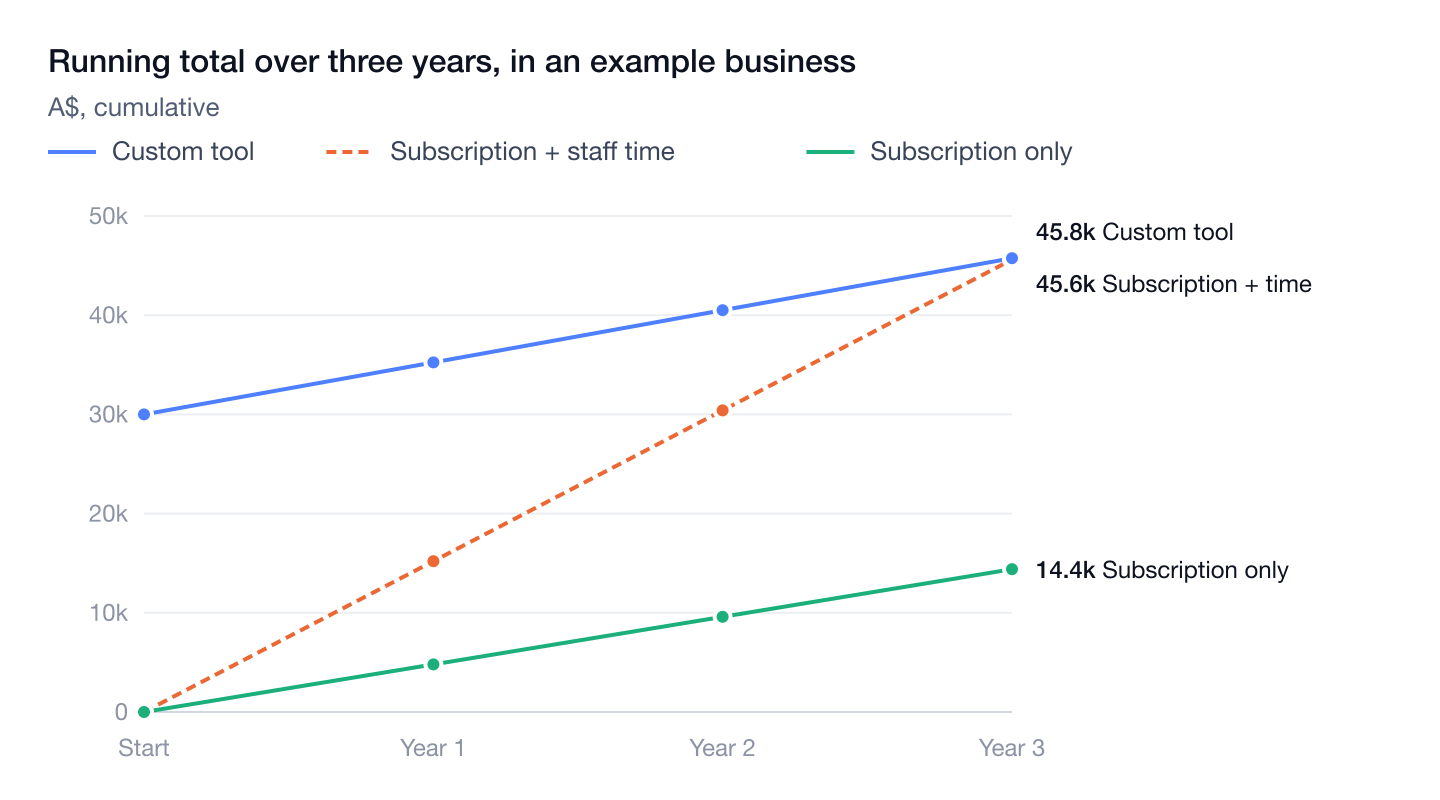
| Off-the-shelf | Small custom tool | |
|---|---|---|
| Upfront | A$0 | A$30,000 |
| Each year | A$4,800 in fees, plus A$10,400 of staff time | A$4,500–6,000 in maintenance |
| Three-year total | A$14,400 in fees, or A$45,600 with staff time | A$43,500–48,000 |
On fees alone, the subscription wins easily. Custom pays off when it removes work the subscription can’t: here, five hours a week of re-typing worth A$10,400 a year. Counting that time, the two come out about even after three years, and custom pulls ahead after that. Swap in your own numbers.
Where no-code fits
- Good for internal tools, simple customer portals, and testing an idea before paying for a build.
- Limits: complex logic and heavy use can get slow or expensive, and moving the app to another platform usually means rebuilding it.
- Price example: Bubble, one of the larger platforms, lists plans from free (for building only, with no live app on your own domain) to US$549 a month, billed annually.
- A common path: prove the idea on a no-code tool, then rebuild it as custom software once people rely on it.
Using both
Most small businesses don’t have to pick one. Keep standard tools for standard jobs and connect them:
- Automation services such as Zapier and Make link common tools for a monthly fee, with no developer needed for simple flows.
- A developer can build a direct connection where those services fall short, typically for A$5,000–20,000 each.
- Build custom only for the part that’s specific to you, such as a quoting tool that sends invoices to your accounting software.
Before you sign up for any software
Most software subscriptions are standard form contracts: the vendor writes the terms and you take them or leave them. Since November 2023, small businesses have been protected from unfair terms in these contracts, and a business that uses such terms can be penalised. Security deserves the same attention: in 2024–25, 21% of Australian businesses reported a cyber security incident, and 28% had no measures in place to prevent one, according to the ABS.
- Can we export all our data, and in what format?
- How does the price change as we add users or customers?
- Where is our data stored, and how is it protected?
- What happens to our data if we cancel?
- Does it connect to the other tools we already use?
Sources
- Australian Bureau of Statistics: Characteristics of Australian Business, 2024–25
- Legal Services Commission of South Australia, Law Handbook: Unfair contract terms
Build prices, maintenance percentages and connection costs are rounded from 2026 price guides published by Australian software firms. No-code prices are from the platform’s published plans (October 2026). Subscription fees and staff time in the example are illustrative.
Built well. Costs less. Backed by real engineers.
AI builds your software; engineers check the work and look after it once it's live.