Why the gap with your competitors grows a little every year
Updated October 15, 2026 · 3 min read
Process improvements rarely look dramatic in a single week. They show up over years, because they compound: a business that removes a little friction every year ends up well ahead of one that doesn’t, even if both started level. The OECD’s 2026 figures point the same way. The widest productivity gaps are between firms of the same size in the same industry, which means they come from how the work gets done.

A flat economy makes small gains stand out
Australia’s labour productivity growth has averaged under 0.3% a year since 2015, against a 60-year average of 1.6%, the Productivity Commission said in March 2026. Its September update put the economy barely 1% above its 2015–19 average level of productivity.
When the economy as a whole is barely moving, a business that gets a little better every year doesn’t have to be brilliant to pull ahead. It only has to keep going.
The gap is inside industries, not between them
The OECD’s 2026 Compendium of Productivity Indicators found that small and medium firms produce, on average, about 65% as much per person as large firms, and that the gap has widened in 20 of 32 countries since 2013. But size isn’t the main story. Within an industry, around 95% of the variation in productivity is between firms in the same size class.
Put simply, two plumbing businesses with ten staff each can differ more from each other than a small firm differs from a large one. What separates them is how the work is organised: how quotes go out, how jobs are scheduled, how stock is tracked, and how quickly mistakes are caught.
How small improvements compound
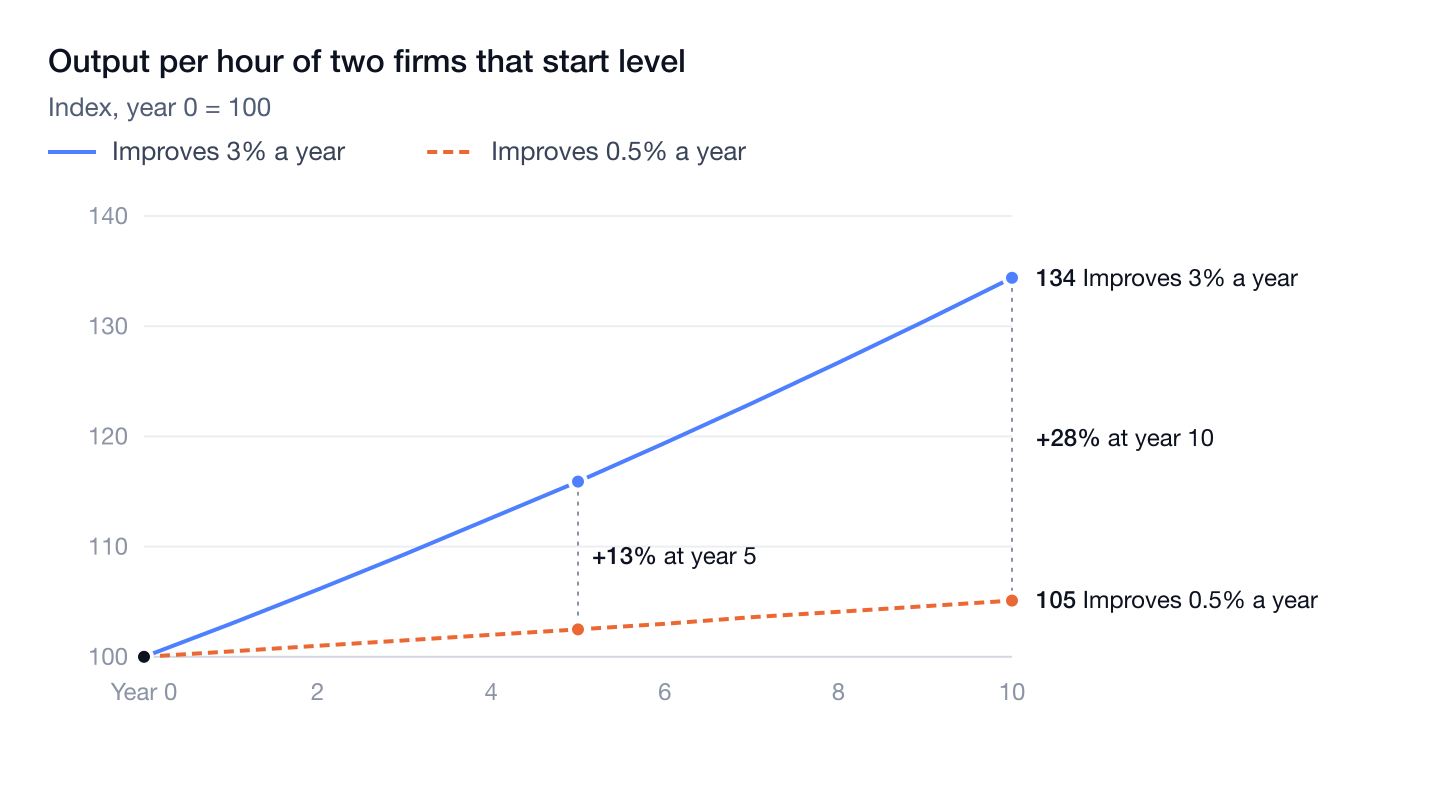
Neither firm does anything dramatic. One removes a few hours of re-keying here and a slow approval there, every year. After five years it produces about 13% more for each hour of work than its competitor. After ten, about 28% more. That’s the difference between quoting the same job lower and still earning more, or taking on more work without hiring.
Where the gap actually shows up
- Speed. Quotes and replies go out the same day, so more of them are accepted.
- Fewer errors. Less copying between systems means fewer wrong orders, invoices and deliveries.
- Capacity. The same team handles more work, so growth doesn’t wait for hiring.
- Better decisions. The numbers are there when you need them, not at the end of the month.
- People. Staff spend their time on customers rather than on paperwork, and tend to stay longer.
None of these shows up as a headline in a single quarter. Each one adds a little to the next year’s starting point.
A real example: seven years from decision to payoff
In October 2018, Coles signed an agreement with Witron to build two automated distribution centres, and in March 2019 it signed with Ocado to build automated online fulfilment centres. The projects took years and ran into delays; the online centres opened in 2024.
In its half-year results in February 2026, Coles reported that its automation programs were “delivering tangible benefits”. Supermarket online sales grew 27%, and over Christmas it recorded its best monthly rate of deliveries in full and on time since December 2020.
A small business isn’t Coles, but the shape is the same. The cost comes first, the learning takes longer than planned, and the benefit arrives later, then keeps arriving. A competitor that didn’t start is now years behind, not months.
What this means for a smaller business
The useful question isn’t whether one improvement pays for itself this quarter. It’s where you will stand against competitors in five years if you keep removing friction and they don’t. Start with one process that happens every day and follows the same rules each time, measure how long it takes now, improve it, and then move to the next.
Sources
- Productivity Commission: Quarterly productivity bulletin, March 2026
- Productivity Commission: Productivity update, September 2026
- OECD: Compendium of Productivity Indicators 2026, labour productivity across firm sizes
- Coles Group: 2026 half year results release (February 2026)
- Wesfarmers: Coles supply chain modernisation (ASX announcement, October 2018)
Built well. Costs less. Backed by real engineers.
AI builds your software; engineers check the work and look after it once it's live.