How much does custom software cost in Australia?
Updated November 2, 2026 · 3 min read
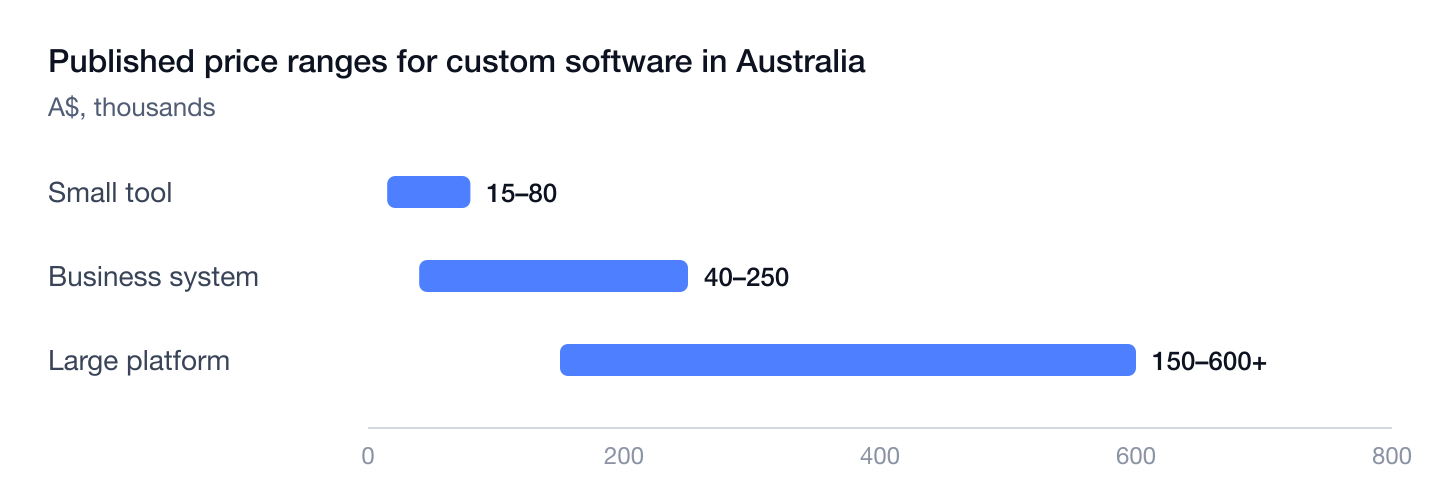
For custom software in Australia, price guides published by Australian software firms put a small internal tool at about A$15,000–80,000, a business system such as a CRM, booking system or client portal at A$40,000–250,000, and a large platform at A$150,000 or more. Local developers charge roughly A$100–250 an hour. After launch, budget another 15–20% of the build cost each year to keep it running.

Price ranges by size
| Size | Typical examples | Time to build |
|---|---|---|
| Small tool | An internal dashboard or report, a form that feeds a database, a quoting calculator | 2–4 months |
| Business system | A custom CRM, a client portal, bookings and scheduling with payments | 4–7 months |
| Large platform | A software product sold to customers, an ERP replacement, a system with heavy compliance needs | 6–18 months |
Which businesses need custom software
Ready-made software is the right answer for accounting, payroll and email, and for most bookings and online shops. Custom software starts to pay off when:
- The way you work is your edge, such as quoting rules, scheduling constraints or a service process that no package models.
- People retype the same data between several tools that don’t talk to each other.
- Customers or staff need one view of information spread across systems, such as a client portal.
- Per-user subscriptions keep growing with your team, until their cost over three to five years approaches a build.
If none of these is true, start with ready-made tools and revisit when one becomes true.
Why the same idea gets very different quotes
- Types of users. Every extra type, such as staff, customers and admins, needs its own screens, permissions and testing.
- Connections to other systems. Each link to your accounting software, payments or CRM adds design, building and testing. One Australian firm’s 2026 guide puts each connection at A$5,000–20,000.
- Existing data. Moving records out of spreadsheets or an old system means cleaning and checking them first.
- Security and compliance. Health, financial and personal information needs extra work and review.
- Deadlines. Squeezing the schedule usually costs more.
- Who builds it. Offshore teams usually cost less per hour; local teams share your working hours.
What the hourly rate tells you
An employed software developer in Australia earns a median of A$67 an hour, according to Jobs and Skills Australia. Local agencies charge about A$100–250 an hour and freelancers about A$50–140, because their rate also covers unbilled time, equipment, insurance, super and profit.
A quote is roughly hours multiplied by rate. When two quotes for the same brief differ two or three times over, ask each for the hours behind it. The gap is usually in what each one thinks is included.
Running costs after launch
- Maintenance and support: about 15–20% of the build cost every year.
- Hosting: from tens of dollars a month for a basic setup to several hundred for cloud servers.
- New features: billed by the hour or as a monthly retainer.
For example, a A$60,000 system costs about A$9,000–12,000 a year to maintain, before hosting and new features.
Five ways to spend less
- Build the smallest version that solves the main problem, then add to it once people are using it.
- Use ready-made tools for standard jobs such as accounting, payroll and email, and build only what’s specific to your business.
- Write down what the software must do before asking for quotes, so every quote prices the same thing.
- Ask for a fixed price on a written scope, or an estimate with a cap.
- Get independent advice first. Small businesses can get up to five hours of digital advice for a small fee through the government’s Digital Solutions program.
How to compare quotes
- Included or extra: design, testing, launch, training and a warranty period.
- Monthly fees: hosting and third-party services such as maps, SMS and payments. Who pays, and how much?
- Ownership: the contract assigns the code to you, and the code and hosting sit in accounts in your name.
- GST: whether the price includes it.
- Payments: tied to working milestones, not mostly upfront.
Sources
- Jobs and Skills Australia: Software and Applications Programmers, earnings from the ABS Survey of Employee Earnings and Hours
- business.gov.au: Digital Solutions – Australian Small Business Advisory Services
Price ranges, build times, connection costs and running-cost percentages are rounded from 2026 price guides published by Australian software firms. They are not quotes. Check whether a quote includes GST.
Built well. Costs less. Backed by real engineers.
AI builds your software; engineers check the work and look after it once it's live.