Where can a small business find an affordable software developer?
Updated October 15, 2026 · 4 min read
Most small businesses find one through a freelance platform, a local agency found through a directory or referral, an offshore team, or a no-code tool they set up themselves. Expect roughly A$50–140 an hour for an Australian freelancer and A$100–250 for a local agency. A clear brief and a fixed quote usually save more than a lower rate.

Four places to look
| Route | Typical rate | Best for |
|---|---|---|
| Freelancer | A$50–140/hr | One feature, a fix or a simple tool |
| Local agency | A$100–250/hr | A business system that needs ongoing support |
| Offshore team | US$15–50/hr in Asia, more in Eastern Europe | A larger build with a detailed brief |
| No-code tool | Free to a few hundred US$ a month | An internal tool, or testing an idea |
Rates are published estimates, not quotes. Check whether a quote includes GST.
What a developer costs per hour
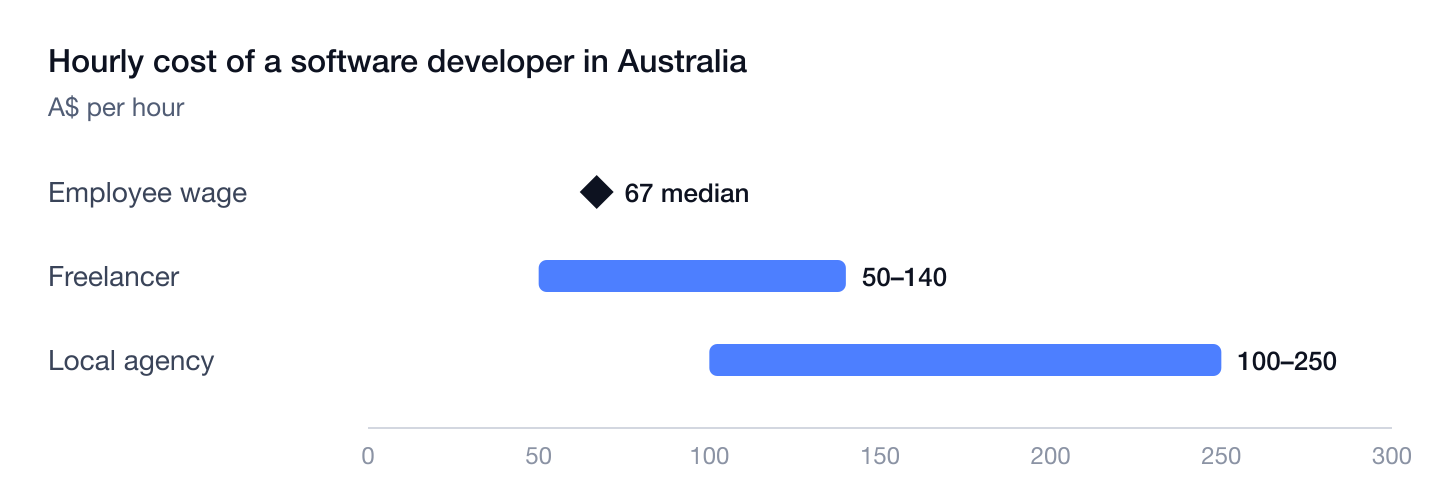
The official benchmark is what an employed developer earns. Across 203,200 software and applications programmers, median pay is A$67 an hour, or A$2,537 a week full time, according to Jobs and Skills Australia. Freelancers and agencies charge more because their rate also has to cover time they can’t bill, equipment, insurance, super and profit.
What an affordable project costs
Hourly rates only matter once you know the size of the job. Price guides published by Australian software firms in 2026 put a small internal tool at roughly A$15,000–80,000. On Clutch, a business review platform, the most common rate among listed developers worldwide is US$25–49 an hour, and most reviewed projects come in between US$10,000 and US$49,000.
With a budget under about A$15,000, the realistic options are a freelancer, an offshore team, a no-code tool, or a smaller first version of what you want.
Where to look, and what to watch for
Freelancers
Look on platforms such as Upwork, Freelancer.com and Airtasker, ask other business owners for referrals, or try local tech meetups.
- Post a short brief with a budget range, rather than asking for rates.
- Shortlist people who have built something similar and can show it working.
- Start with a small paid task of a week or less before committing to the whole job.
- Watch for: one person is a single point of failure, and you manage the work.
Local agencies
Search directories such as Clutch, GoodFirms and DesignRush by city and budget, or ask your accountant or industry association.
- Read what each review says about the project, not just the stars.
- Directories sell placements, so check whether a top listing is marked as sponsored.
- Ask each agency for one past client you can call.
- Watch for: higher prices and minimum project sizes.
Offshore teams
Use the same directories, filtered by country. The rates above are what developers earn; agencies add their margin on top.
- Choose a team whose hours overlap with yours, with one named person responsible for your project.
- Ask for a demo of working software every week, not just status reports.
- Watch for: time zones, communication and very uneven quality.
No-code tools
Platforms such as Bubble, Glide and Softr let you build a simple app yourself, without writing code.
- Start from a template close to what you need.
- Check the plan’s usage limits before your business relies on it.
- Watch for: the app can’t easily move to another platform later.
Low-cost advice before you hire anyone
Small businesses with fewer than 20 full-time staff, and sole traders, can get up to five hours of one-on-one digital advice for a small fee through the Australian Government’s Digital Solutions program, plus free workshops and webinars. Advisers cover business software and AI, so they can help you decide whether you need custom software at all. Each state has its own provider, listed on business.gov.au.
Five questions that keep the cost down
- What exactly is included, and what isn’t? Design, testing, launch, training and a warranty period are often priced separately.
- Is this a fixed price or an estimate? Ask what happens when the scope changes.
- Who owns the code? Under Australian copyright law, whoever writes it owns it unless they’re your employee or they assign it to you in writing. Paying for it doesn’t change that on its own.
- Whose accounts will the code and hosting live in? Ask for them to be in yours from day one.
- How are payments split? Tie them to working milestones rather than paying most of it upfront.
Red flags in a cheap quote
- A price before anyone has asked how your business works.
- No written list of what you’ll get.
- Code and hosting kept in the developer’s accounts, with no handover.
- No way to see progress until the end.
Sources
- Jobs and Skills Australia: Software and Applications Programmers, earnings from the ABS Survey of Employee Earnings and Hours
- Clutch: Software development company pricing guide 2026 (updated September 2026)
- business.gov.au: Digital Solutions – Australian Small Business Advisory Services
- Legal Services Commission of South Australia, Law Handbook: Who owns copyright?
Freelance, agency, offshore and no-code figures are rounded ranges from 2026 rate guides and price lists published by Australian software firms, freelance-rate trackers, offshore staffing firms and platform vendors. They are not quotes. Check whether a quote includes GST.
Built well. Costs less. Backed by real engineers.
AI builds your software; engineers check the work and look after it once it's live.